
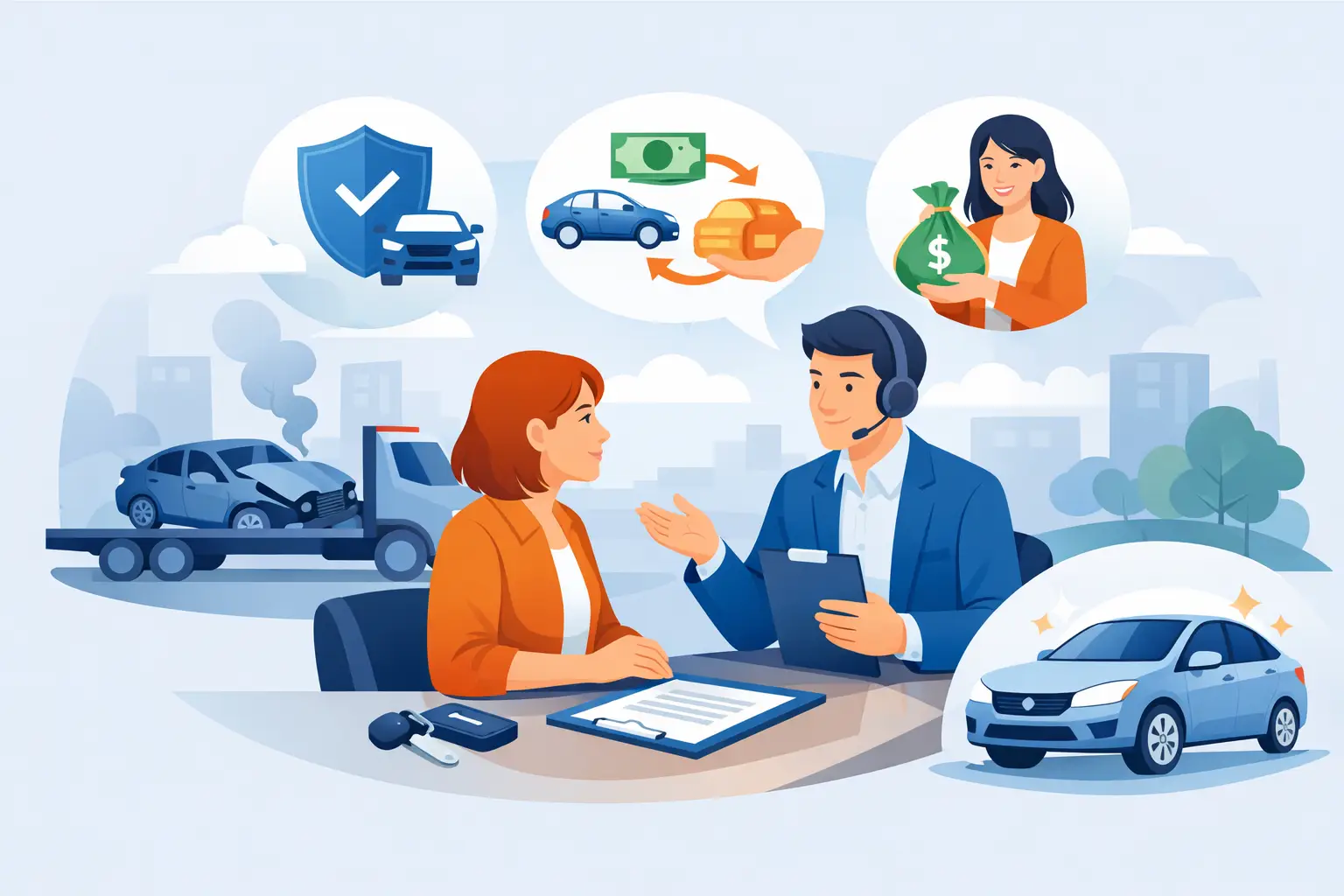
A customer drives off the lot, builds a routine around that vehicle, and then one accident changes everything. The car is declared a total loss, the claim process starts, and your borrower is suddenly dealing with transportation problems, payment stress, and uncertainty about what comes next. That is where total loss customer assistance stops being a nice extra and starts becoming a real business advantage.
For lenders, lessors, dealerships, and buy-here-pay-here operators, a total loss event is not just a customer service moment. It is a pressure test for your portfolio, your retention strategy, and your backend product mix. If the only support available is a standard insurance settlement, the customer may still be left with immediate out-of-pocket needs, disrupted payment behavior, and a weaker connection to your business. Strong assistance in that moment can protect the customer and your bottom line at the same time.
What total loss customer assistance should really do
Many automotive businesses treat total loss support as a claims issue that belongs somewhere else. That approach misses the larger opportunity. In practice, total loss customer assistance should help stabilize the customer during one of the most disruptive ownership events they can face.
That means the assistance needs to do more than acknowledge the loss. It should create practical financial relief fast enough to matter, and it should support the path back into a replacement vehicle. If the product or program only sounds good in the F&I office but does very little when a customer actually needs help, it will not strengthen loyalty or improve performance.
The strongest assistance models address the real gaps customers feel first. They need help with transportation, travel, and immediate miscellaneous expenses. They may also need support replacing the vehicle so they can stay mobile and, in many cases, remain in a payment relationship. Those are not abstract benefits. They directly affect customer satisfaction, repayment stability, and the likelihood of keeping that customer in your ecosystem.
Why total loss customer assistance matters to automotive finance partners
A total loss can interrupt more than transportation. It can interrupt payment habits, dealership relationships, and future financing opportunities. When a borrower loses use of a vehicle unexpectedly, the stress shows up quickly. Even customers with insurance may face delays, deductible issues, and a short-term cash crunch before they are ready to replace the vehicle.
That is where automotive businesses can separate themselves. Total loss customer assistance gives you a more complete answer to a customer problem that standard products often leave partially solved. Instead of offering sympathy and hoping the customer finds their way back, you can offer a concrete benefit that supports continuity.
For a dealer, that can mean better customer goodwill and a stronger chance of bringing the buyer back for another vehicle. For a lender or lessor, it can mean less disruption around the account and a better overall customer experience. For BHPH operations, where payment interruption can become a serious operational problem fast, the value is even more direct.
There is also a revenue story here. Ancillary products that provide visible consumer value are easier to position, easier to explain, and more likely to reinforce satisfaction after the sale. If the product performs when the customer needs it most, it supports both per-deal income and long-term trust. That trade-off matters. A high-margin product with weak real-world value may boost short-term numbers, but it rarely builds retention.
The gap between insurance and real customer relief
Insurance plays a major role in a total loss event, but insurance alone does not always cover the customer experience. That gap is exactly why this category matters.
An insurance settlement may address vehicle value, but it does not necessarily solve for immediate travel expenses, temporary transportation needs, or the financial friction of getting into a replacement vehicle. Customers feel that gap right away. They still need to get to work, pick up their kids, and manage the expenses that pile up while the loss is being processed.
From a business standpoint, that gap creates risk. A customer under financial pressure is less predictable. They may delay decisions, disengage from your team, or move to another provider when they are ready to replace the vehicle. Total loss customer assistance gives your organization a way to step into that gap with a practical answer rather than a passive response.
This is also why the non-insurance positioning matters. A reimbursement-based membership can complement the broader ownership and finance experience without pretending to replace an insurance policy. For many partners, that distinction makes the product easier to integrate into an ancillary strategy built around real customer events.
What decision-makers should look for in a total loss assistance offering
Not every product marketed around vehicle hardship creates measurable value. If you are evaluating total loss customer assistance, the test is simple. Can your team explain it clearly, can the customer use it easily, and does it improve outcomes that matter to your business?
Clarity matters first. F&I managers and sales teams need an offer that can be presented in plain language without turning the conversation into a compliance headache. Customers should quickly understand what event is covered, what reimbursement is available, and why it is relevant to their ownership risk.
Speed matters next. If benefits are too limited, too delayed, or too hard to access, the product loses credibility. Immediate expense support carries weight because it addresses the first financial shock after a total loss. Replacement vehicle assistance also matters because it helps move the customer from disruption to action.
Then there is the operational question. A strong program should support more than a single claim event. It should fit into your revenue model, strengthen your retention strategy, and give your team something useful to sell rather than something they have to defend. That is where programs like CPR For Cars stand apart, because the value proposition is built around both customer relief and partner performance.
How assistance supports revenue, retention, and return traffic
The best aftermarket products do not force you to choose between helping customers and improving gross. Total loss customer assistance can do both when it is structured correctly.
On the front end, it adds a monetizable benefit that sales and F&I teams can position around a real-world problem. On the back end, it creates a better ownership experience when a covered event happens. That combination matters because customers remember who helped them during a difficult moment.
For dealerships, there is another advantage. If the assistance includes support toward a replacement vehicle, you create a stronger path back into your store. That can mean another vehicle sale, another finance opportunity, and another chance to keep the customer relationship active instead of losing it after the first disruption.
For lenders and lessors, better customer support during total loss events can reinforce portfolio stability. It will not eliminate every account problem, and it is not a cure-all for credit risk. But it can reduce the intensity of payment disruption by giving customers practical help at the moment stress peaks. In a business where small improvements in behavior can create meaningful portfolio impact, that is a serious benefit.
Positioning total loss customer assistance the right way
If you want adoption, the message cannot be vague. Your teams need to present the product as direct financial relief tied to a disruptive event customers can easily imagine. Most buyers understand the risk of an accident. What they often have not considered is how expensive the aftermath can feel even when insurance is involved.
That makes the conversation straightforward. Explain the event, explain the reimbursement, and explain the recovery value. Keep the focus on payment continuity, immediate expenses, and replacement support. When the benefit is tangible, the product becomes easier to sell and more likely to be appreciated later.
At the same time, decision-makers should avoid overselling. Customers need a clear explanation of what the membership is and is not. That protects trust and supports cleaner execution. A commercially strong product is not just one that sells well. It is one that delivers as presented.
The market does not need more generic add-ons. It needs products that give automotive businesses a sharper way to protect customers while improving performance. Total loss customer assistance does exactly that when it is built around real reimbursement, real customer use, and real business outcomes.
If your current offering does not help customers bridge the gap between a total loss and their next step, there is room to improve. The partners that win in this market will be the ones that treat vehicle disruption as both a customer care issue and a revenue opportunity, then act accordingly. Protect the customer when the vehicle is gone, and you give your business a better chance to keep the relationship moving forward.







Leave A Comment