
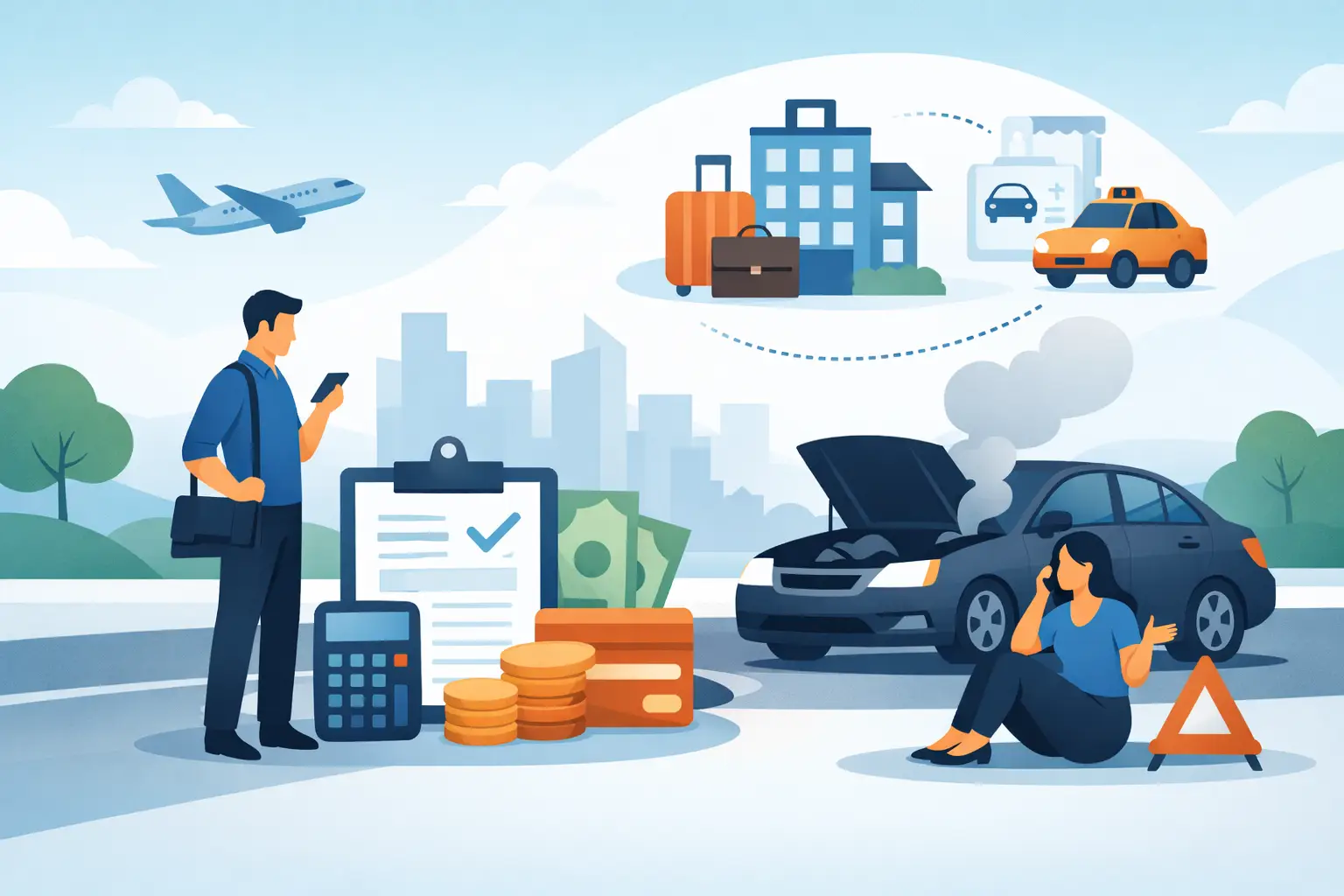
A customer’s car breaks down on Tuesday morning, and by Tuesday afternoon the real damage is already spreading beyond the repair bill. They still need to get to work. They may need a rideshare, a rental, a hotel, or money for meals and basic transportation. That is where travel expense reimbursement after car breakdown becomes more than a nice extra. It becomes a practical tool that protects the customer relationship and reduces the financial shock that can disrupt payment behavior.
For lenders, lessors, dealerships, and buy-here-pay-here operators, this matters because vehicle trouble rarely stays isolated to the vehicle itself. When a covered event leaves a car unusable, the borrower or lessee is suddenly juggling transportation costs and an ongoing monthly payment at the same time. If your product stack does not address that gap, the customer feels the pressure immediately. If it does, your store or portfolio stands out for the right reason.
Why travel expense reimbursement after car breakdown matters
Most automotive finance products focus on the vehicle, the loan, or the lease. Customers, however, experience disruption in much broader terms. A breakdown creates missed work, emergency spending, household stress, and often frustration with whoever sold or financed the vehicle, even when no one caused the failure.
That is why travel expense reimbursement after car breakdown has strategic value. It gives customers help in the exact window when stress is highest and loyalty is most vulnerable. A few hundred dollars toward immediate travel and miscellaneous costs can make the difference between a customer who feels abandoned and one who feels supported.
From a business standpoint, the benefit is just as clear. Customers under sudden financial pressure are more likely to fall behind, delay communication, or look for someone to blame. A reimbursement benefit can soften that pressure and support payment continuity. It also gives your sales and F&I teams a benefit they can explain in plain language: if a covered event leaves the vehicle unusable, the customer may have help with the urgent costs that follow.
What customers actually need after a breakdown
The industry sometimes talks about roadside events in abstract terms. Customers do not. They think in terms of real expenses that start piling up the same day. They may need temporary transportation to get to work, take children to school, keep medical appointments, or continue business travel. In some cases, they may need a hotel if the breakdown happens away from home. Even smaller costs such as meals, local transit, and incidental expenses can add up fast.
That is why a reimbursement benefit tied to immediate travel and miscellaneous expenses has real traction. It addresses the first layer of hardship, not just the long-term repair issue. For the customer, speed and usefulness matter more than product complexity. They want to know whether they have support, what kind of costs may qualify, and how much relief is available.
For partner businesses, that clarity drives adoption. A benefit is easier to sell when the use case is obvious. A customer understands a breakdown. An F&I manager can explain the pain point in seconds. A lender can recognize the connection between emergency expense relief and account stability.
The business case for dealerships and finance partners
Ancillary products perform best when they do two jobs at once: deliver visible customer value and strengthen dealer or portfolio economics. This category can do both.
First, it creates a stronger ownership experience. Customers do not remember only what happened in the showroom. They remember what happened when things went wrong. If your organization offers a membership that can reimburse certain travel and miscellaneous expenses after a covered event, you are not just selling a product. You are building a service position that customers can feel.
Second, it supports payment performance. When a customer is forced to spend unexpected money on transportation, the monthly vehicle obligation does not disappear. The result can be short-term distress that affects collections, delinquency trends, and customer satisfaction scores. Relief at the point of disruption can help reduce that pressure.
Third, it adds backend value. Dealers and finance partners need products that are easy to present, differentiated in the market, and commercially sound. A reimbursement-based membership can generate revenue while also reinforcing retention, goodwill, and service-center return traffic.
That combination matters. Products that only produce margin are easier to replace. Products that produce margin and help stabilize the customer relationship are much harder to walk away from.
Where reimbursement fits in the ownership journey
Travel expense reimbursement after car breakdown is most effective when it is framed as part of a broader protection strategy, not as a standalone talking point with no context. The customer needs to understand that this benefit is about immediate relief during a disruptive vehicle event. The business needs to position it as part of a smarter ownership experience that protects both the driver and the payment stream.
That means training matters. Sales teams should not bury the benefit in vague language. F&I managers should explain the scenario directly: if a covered event leaves the vehicle unusable, the customer may be eligible for reimbursement for certain travel and miscellaneous expenses, subject to program terms and limits. That is a concrete message, and concrete messages sell.
It also means operational follow-through matters. If the claims or reimbursement experience is confusing, the value gets diluted. Customers judge the benefit by what happens when they need it, not by what was said in the showroom. The simpler the process feels, the stronger the goodwill outcome.
What makes this more useful than generic promises
Many dealers and lenders already talk about customer care. Fewer can point to a product that delivers immediate, measurable financial relief tied to an actual disruption event. That distinction matters in competitive environments where everyone claims to care about the customer experience.
A reimbursement benefit works because it is specific. It is not a vague assurance that someone will help. It is a defined dollar-value benefit that can offset urgent costs at the exact moment those costs become a problem. That specificity makes the product easier to explain, easier to value, and easier to remember.
There is also an important trade-off to acknowledge. Not every customer will use the benefit, and not every vehicle issue will trigger eligibility. That is true of any event-driven membership. But the value is not only in frequency of use. It is in the protection promise, the payment-support function, and the confidence it gives both the customer and the business partner before a disruption ever happens.
A stronger product story for modern F&I
F&I leaders are under constant pressure to present products that are relevant, profitable, and credible. Customers have become more selective. Compliance expectations are higher. Generic pitches do not hold attention.
This is where a focused reimbursement membership has an advantage. It solves a problem customers understand without sounding like another commodity add-on. It also gives your team a better conversation. Instead of talking only about mechanical failure, contract terms, or abstract future risk, they can talk about the real-world cash crunch that follows when a vehicle cannot be used.
For finance sources, that same story supports partner value. A program that helps reduce customer hardship can contribute to stronger account behavior and a better brand experience. For buy-here-pay-here dealers, the connection is even more direct. When transportation disruption affects income and routine, payment disruption often follows. A customer benefit that helps bridge that moment deserves attention.
Programs such as CPR For Cars stand out because they position reimbursement as an operational advantage, not just a customer perk. That is the right lens for this market. The best ancillary products do not force a choice between helping customers and driving revenue. They do both.
How to evaluate a reimbursement benefit before offering it
Decision-makers should look past the headline and assess whether the benefit is easy to sell, easy to understand, and easy for customers to use. Reimbursement limits matter. Covered-event language matters. So does the fit with your current F&I menu, lender objectives, and dealership retention strategy.
You should also ask a practical question: will this benefit change how a customer feels when their vehicle becomes unusable? If the answer is yes, the product has real value. If it also generates income and supports payment continuity, it has strategic value.
That is the standard worth using. In a crowded market, the products that last are the ones that relieve real customer pain while protecting the bottom line. When a breakdown turns into a financial interruption, timely reimbursement is not a side feature. It is the part customers remember when they decide whether to stay loyal.






Leave A Comment