
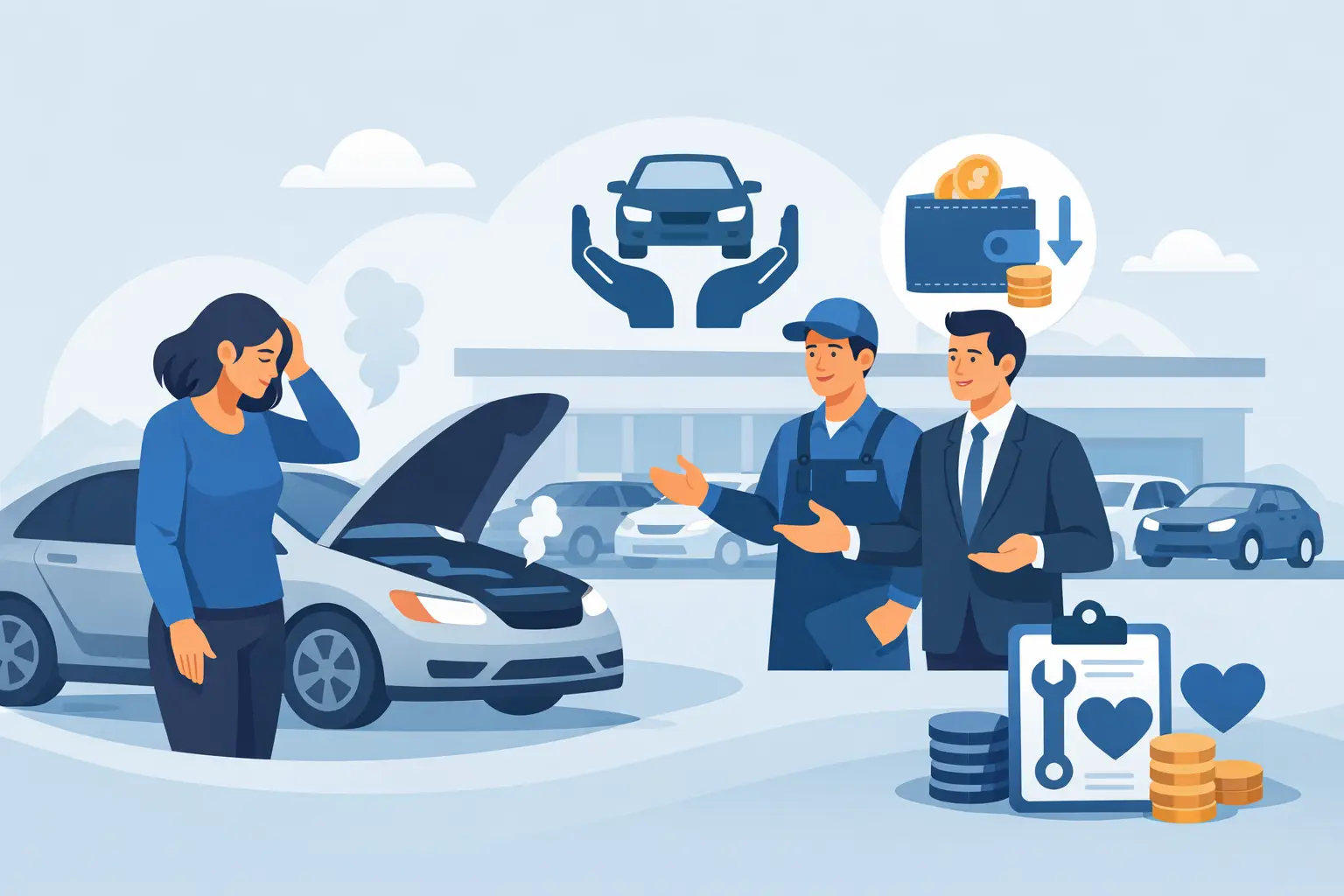
A customer’s car is in the shop, the repair estimate is higher than expected, and the monthly payment is still due. At that moment, customers often ask: do dealerships offer repair hardship help? The honest answer is sometimes, but most dealerships do not have a standard program that covers a customer’s payment or personal expenses while a vehicle is unusable. That gap creates a real customer-care challenge and a real portfolio-performance opportunity.
For dealers, lenders, lessors, and buy-here-pay-here operators, repair hardship is not just a service-lane issue. It can lead to skipped payments, frustrated calls to collections, negative reviews, lost loyalty, and customers taking their next repair or next vehicle purchase elsewhere. The right response is not an improvised discount every time a problem occurs. It is a structured, clearly communicated protection option offered before the hardship begins.
Do Dealerships Offer Repair Hardship Help in Practice?
A dealership may help a customer facing a repair-related hardship, but the form of help varies widely. One store may offer a small goodwill repair discount. Another may provide a loaner vehicle when inventory allows. A service manager may work with a customer on repair timing, or a finance department may refer the customer to their lender for payment-relief options.
These efforts can be valuable, especially when a dealer wants to preserve a relationship. But they are usually discretionary. They depend on store policy, repair circumstances, manufacturer involvement, warranty coverage, available transportation, and the customer’s account status. They are not a predictable benefit a customer can rely on when their vehicle is suddenly out of commission.
That distinction matters. A waived diagnostic fee may ease a repair bill, but it does not solve the customer’s larger problem if they are paying for rideshare trips, missing work, arranging childcare, and trying to make a vehicle payment on time. A loaner can be helpful, but not every store has one available, and it does nothing for a customer whose vehicle is declared a total loss.
For most dealerships, direct hardship assistance also has practical limits. Repeatedly making case-by-case concessions can reduce gross profit, create inconsistent customer expectations, and put employees in the difficult position of deciding who qualifies for help. Goodwill has a place. It should not be the only plan.
Why Repair Downtime Can Become a Payment Problem
Vehicle ownership is built around mobility. When mobility disappears, household finances can get tight fast. The customer may still have a payment, insurance, fuel commitments, and other bills, even though the vehicle they financed or leased cannot be used.
The hardship can be especially sharp for customers who depend on their vehicle to get to work, transport family members, or earn income. A repair that leaves a vehicle unavailable for weeks can create a chain reaction: transportation costs rise, work schedules are disrupted, and the car payment becomes one more pressure point.
From the lender or dealer perspective, that pressure may show up as a late payment or a difficult collection conversation. The account may not be a long-term credit problem at all. It may be a temporary disruption caused by an unusable vehicle. Still, without a clear support mechanism, a short-term event can weaken customer trust and payment continuity.
That is why repair hardship deserves attention at the point of sale, not only after a customer calls in distress. A dealership that offers a relevant membership product can give customers a practical answer before they need one, while creating a differentiated F&I conversation and an additional source of revenue.
What Help Can Dealers Realistically Provide?
Dealerships should be careful not to promise financial assistance they cannot consistently deliver. Instead, they can create a layered customer-support approach built around communication, service access, and optional protection products.
First, service teams can set expectations early. If a repair may involve long parts delays, extensive diagnostics, or a possible total loss, the customer should understand the likely timeline and available transportation options. Clear communication reduces surprises and helps the customer make informed decisions.
Second, stores can coordinate internally. The service department, F&I department, sales team, and lender relations team should know what resources exist and who handles hardship conversations. When customers are passed from one department to another without answers, a manageable concern becomes a loyalty problem.
Third, dealerships can offer products designed for the ownership disruption itself. This is where a payment-reimbursement membership can create a meaningful difference. Unlike an informal goodwill decision, a properly structured membership establishes defined benefits and eligibility terms that can be explained at delivery.
The trade-off is straightforward: customers must understand that benefits are subject to membership terms, covered events, documentation requirements, and applicable limits. Dealership teams should not present any protection product as a blanket promise to pay every expense from every repair. Accuracy protects the customer, the dealership, and the program’s credibility.
A Better Model: Protection That Supports Payments
Car Payment Reimbursement is designed around a simple reality: when a covered event leaves a vehicle unusable, customers may need help keeping their monthly vehicle payment on track. Rather than asking a dealer to absorb a hardship expense after the fact, the membership provides a defined reimbursement benefit for qualifying situations.
For CPR For Cars partners, the model can also include up to $500 for immediate travel and miscellaneous expenses in the first year, along with up to $1,000 toward a replacement vehicle after a total loss based on the customer’s down payment with the original dealer. These benefits address the practical costs customers feel first, while reinforcing the value of returning to the originating dealer.
This is not traditional insurance, and it should not be positioned as such. It is a membership-based protection product with specific terms and conditions. That clarity is a strength. Customers receive a tangible explanation of how the product may help during a disruptive vehicle event, while dealer and finance partners gain a product that supports their customer-care and revenue objectives.
Why This Matters to F&I and Portfolio Performance
A repair-hardship conversation is often treated as an exception. For a high-performing automotive business, it should be viewed as a predictable ownership risk with a monetizable solution.
F&I managers need products that customers can understand without a lengthy technical explanation. “If a covered event leaves your vehicle unusable, this membership may reimburse your monthly payment and help with immediate expenses” is a conversation tied directly to the customer’s real-world concern. It is different from selling protection only around mechanical breakdowns or appearance issues. It focuses on the financial disruption that follows vehicle downtime.
Lenders and lessors have a related interest. A customer who has support during an unforeseen vehicle event may be better positioned to maintain payment behavior and remain engaged with the account. No product eliminates every delinquency risk, and no responsible partner should claim that it does. But adding a defined hardship-related benefit can strengthen the ownership experience when it matters most.
For dealers, there is also a retention advantage. When a customer sees the original dealership as the place that helped protect them through a difficult event, that dealership has a stronger reason to earn the next service visit, replacement purchase, and referral. Protection can create goodwill, but it can also drive measurable residual business.
How to Position Repair Hardship Help Without Overpromising
The most effective presentation is direct and specific. Avoid vague statements such as “we will take care of you no matter what happens.” Customers hear that as a guarantee, and it creates problems when a situation falls outside program terms.
Instead, explain the customer problem, the available benefit, and the conditions. A sales or F&I professional can say that a vehicle being unusable may create both transportation expenses and payment pressure. They can then explain that the membership is intended to provide defined reimbursement support when a covered event occurs.
Operational discipline matters after the sale as well. Partners should train employees on eligibility basics, documentation expectations, customer handoffs, and compliant language. Service advisors should know that a customer with a qualifying membership may need guidance when an extended repair begins. Lender and lease teams should know how to direct customers to the proper process rather than improvising account solutions.
Turn a Difficult Moment Into a Stronger Relationship
Customers do not measure a dealership relationship only by the vehicle they bought. They remember what happened when that vehicle became a problem. A repair hardship can expose a gap between a dealer’s promise of customer care and the help it can actually provide.
The strongest operators close that gap before delivery. By offering a clearly defined payment-reimbursement membership, they can protect customers from some of the financial strain of covered vehicle disruptions while protecting revenue, retention, and the long-term value of the relationship. That is a better answer than hoping a service-lane goodwill decision will be enough.








Leave A Comment